Key Takeaways
- Both the DSc and PhD are research-focused doctoral degrees, but their emphasis and application can differ by program and institution.
- A Doctor of Science (DSc) often emphasizes original scientific research with practical applications in professional, educational, organizational, or community settings.
- A PhD often emphasizes original scholarly research that advances disciplinary knowledge, theory, or conceptual understanding.
- ACHS offers a Doctor of Science (DSc) in Integrative Health. Graduates can apply their advanced expertise to lead innovation, strengthen evidence-informed practice, educate others, and contribute to the continued development of the integrative health field.
For health and wellness professionals who want to advance research, education, and professional practice, pursuing a doctoral degree can be a meaningful next step. But choosing the right type of doctorate requires understanding how different research degrees are structured and how they align with your goals.
Two common research-focused doctoral pathways are the Doctor of Science (DSc) and the Doctor of Philosophy (PhD). While both are terminal degrees that involve advanced study and original research, they often differ in their emphasis, approach, and professional applications.
If you’re a professional interested in integrative health and wellness, understanding these differences can help determine which doctoral pathway best supports your goals in research, education, community health, and evidence-informed practice.
What Is a Doctor of Science (DSc)?
 A Doctor of Science is a research-focused doctoral degree designed to advance scientific knowledge and apply research to specialized fields. DSc programs often emphasize practical applications of research, professional expertise, and contributions to industry or community-based solutions.
In integrative health, a DSc can support professionals seeking to advance research and practice in holistic approaches to wellness, functional nutrition, herbal medicine, aromatherapy, health education, and emerging areas of whole-person health.
A DSc program may be a strong fit if you want to:
- Conduct original research that addresses real-world health and wellness challenges
- Apply specialized expertise to advance integrative health research, education, and practice
- Educate and mentor future practitioners and health professionals
- Contribute to community health initiatives and health policy discussions
- Deepen their expertise in a specialized area of integrative health
What Is a PhD?
 A Doctor of Philosophy (PhD) is one of the most widely recognized research doctorates. PhD programs typically focus on generating new knowledge through scholarly research, often with an emphasis on theory development, academic investigation, and contributions to a specific field of study.
PhD graduates may pursue careers in academia, research institutions, industry, and government. Depending on their discipline and role, their work may include conducting laboratory, clinical, social science, or theoretical research; publishing peer-reviewed studies; and teaching or mentoring at colleges and universities.
A PhD may be a good fit if you want to:
- Advance disciplinary knowledge through academic research and theory development
- Pursue faculty positions in research-intensive institutions
- Conduct in-depth research within a discipline or across related fields
- Contribute to scholarly literature and scientific inquiry
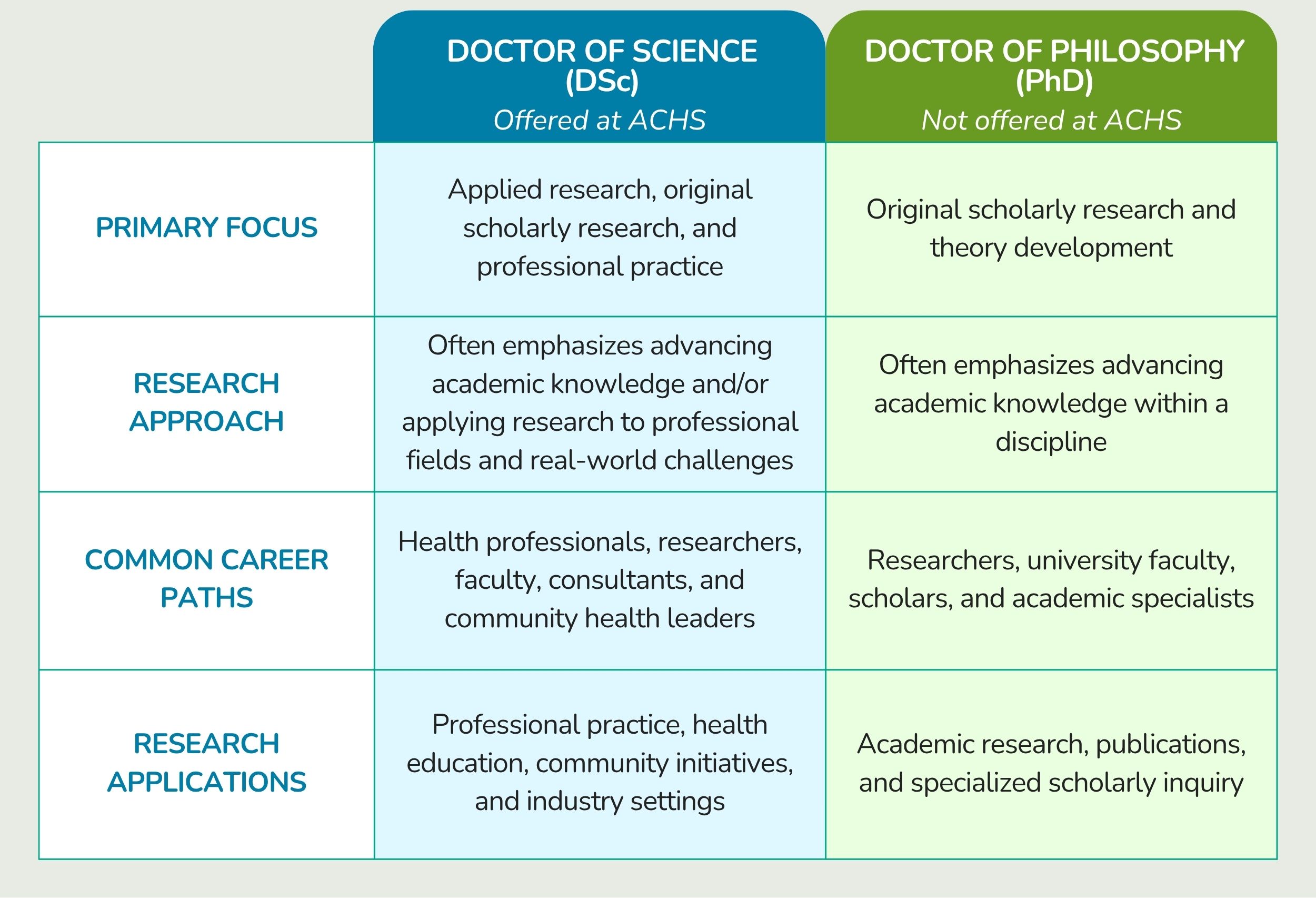
DSc vs. PhD: Key Differences
Although both degrees require advanced research and a doctoral dissertation or research project, the focus and outcomes may differ.
The right choice depends on your background, interests, and long-term goals. Both degrees require dedication to research and a commitment to expanding knowledge within a field.
Doctoral Research in Integrative Health
As interest in integrative health and wellness continues to grow, there is an increasing need for professionals who can evaluate research, contribute new knowledge, and apply evidence-informed approaches responsibly.
 Research in integrative health may explore topics such as:
- Functional nutrition and dietary patterns
- Botanical therapeutics and herbal research
- Aromatherapy and essential oil science
- Mind-body approaches to wellness
- Integrative approaches to mental wellness
- Integrative approaches to chronic health concerns
- Integrative approaches to longevity and healthy aging and women’s hormonal health
Because integrative health draws from multiple disciplines, doctoral-level research requires an understanding of research methods, ethical considerations, scientific literature, and professional scope of practice.
The ACHS Doctor of Science in Integrative Health
ACHS designed the Doctor of Science in Integrative Health degree for health and wellness professionals who want to contribute to research, education, and the future of healthcare.
This fully online doctoral program is designed for practitioners, educators, healthcare professionals, and others who want to help reshape how healthcare works through evidence-informed integrative health approaches.
The ACHS DSc program prepares graduates to:
- Deepen your specialized expertise in integrative health, with a focus on areas such as functional nutrition, aromatherapy, or herbal medicine
- Bring research into practice by translating scientific evidence into informed approaches to health and wellness
- Advance integrative health through research by conducting original studies, contributing to collaborative research projects, and sharing findings that inform whole-person health approaches.
- Empower others through education by creating research-informed programs and resources that support whole-person health
- Extend your impact through collaboration by building partnerships and leading initiatives that support community and global health
- Support more inclusive approaches to wellness with a deeper understanding of the social, economic, cultural, and ethical influences on health
- Strengthen your professional foundation through ethical leadership and responsible practice within your area of specialization
Watch the video below for a more in-depth overview of the ACHS DSc program.

Professional Credential Pathways
The ACHS Doctor of Science in Integrative Health program aligns with professional credentialing educational standards, including those established by the National Association of Nutrition Professionals (NANP) and the American Nutrition Association’s Board Certification for Certified Nutrition Specialists® (CNS®).
Program highlights include:
- Approved by the National Association of Nutrition Professionals (NANP)
- Meets education requirements for graduates to sit for the Board Exam in Holistic Nutrition certification offered by the Holistic Nutrition Credentialing Board
Is a DSc Right for You?
Choosing a Doctor of Science (DSc) starts with identifying how you want to use your research expertise. If your goal is to combine research with professional practice, community impact, health education, or applied solutions in integrative health, a DSc from ACHS may align best with your interests.
For integrative health professionals seeking to conduct research and apply findings in real-world settings, a Doctor of Science can provide the tools needed to make meaningful contributions to the field.
Are you ready to get started, but still not quite sure which pathway is right for your goals?
- Speak to an ACHS Admissions Advisor
- Request More Information about ACHS Programs
- Explore All ACHS Programs
This article is for informational purposes only. Please contact ACHS Admissions at [email protected] or 800-487-8839 for additional information and to apply for admission. Graduation from any ACHS program does not confer a license to practice medicine. ACHS graduates do not claim to treat, diagnose, cure, or prescribe. Please note that professional success is achieved by a number of factors beyond education and experience, including soft skills, work ethic, integrity, and other skills that may not be developed through education and training alone. Not all graduates will achieve the career outcomes provided as examples in this article and other ACHS marketing materials.